
What is white-label ticketing software?
White-label ticketing software lets a business offer ticket sales under its own brand while another company supplies some or all of the underlying technology. The customer might see the business’s name, website, checkout and confirmation emails rather than the technology provider’s brand. How much control the business has over the booking journey, payments, integrations and customer data depends on the particular platform and agreement.
The distinction matters: white-label describes how the service is presented, not automatically how much of the technology or commercial operation the business controls.
How does a white-label ticketing platform work?
There are usually three parties: the business whose brand customers recognise, the technology provider operating some or all of the ticketing system, and the customer purchasing a ticket. An organiser may also be involved when a ticketing business sells on behalf of events it does not operate.
In a typical arrangement:
- The ticketing business sets up an event or receives event information from an organiser.
- Customers discover and buy tickets through a website or booking flow presented under that business’s brand.
- The underlying ticketing technology manages functions such as availability, orders, ticket issuance or access rules, according to the service supplied.
- The business, organiser and technology provider each carry out the operational and commercial responsibilities agreed between them.
Example (hypothetical): A regional ticketing company called Northstar Tickets has relationships with local theatres. Customers buy from northstartickets.example, receive Northstar-branded confirmations and contact Northstar for help. A specialist supplier runs the inventory and order services behind the scenes. Northstar owns the brand that buyers see, but its payment settlement, data permissions and technical responsibilities still depend on its agreements.
A white-label arrangement therefore does not necessarily mean the branded ticketing company processes card payments, acts as merchant of record or can change every part of the checkout.
An implementation example helps illustrate how branding and integration control are different: Eventbrite’s embedded checkout documentation describes a booking widget with configurable colours but fixed parts of the checkout flow. This does not define white-label ticketing generally; it shows why buyers should evaluate each layer of control independently.
What can be customised in white-label ticketing?
Providers can offer very different levels of control. The table below describes possible delivery models, not guaranteed packages or official industry tiers.
An organisation should evaluate these areas separately. Removing a supplier logo does not show that an API is available. Using a custom domain does not establish who controls the customer record. And a custom frontend does not, by itself, grant the ability to select any payment gateway.
What do domains, communications and localisation add to white-label branding?
Brand control extends beyond logos and colours. A ticketing business may need its own shop domain, a consistent company identity in customer communications, and booking experiences that use the appropriate language, currency, time zone and date or time format. These settings affect whether the service feels like part of the business’s own operation—not just how it looks.
For example, Nuweb publicly describes branded ticketshops, localised customer-facing language and currency, and configurable business operations. The exact URL, redirect, communication and localisation behaviour should be demonstrated for the intended markets.
A branded URL and a canonical URL serve related but different functions: the branded URL is the address customers use, while a canonical URL signals the preferred address for indexing when equivalent pages exist. Neither one determines who owns customer data or processes payments.
Is white-label ticketing more than changing a logo?
It can be, but it does not have to be. The term is used for both relatively simple rebranding and more deeply configurable ticketing systems.
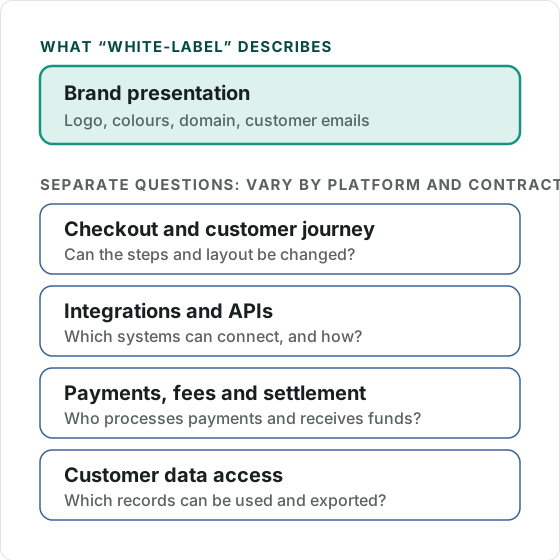
Consider two implementations for the same theatre group:
- Branded checkout: The group applies its logo, colours and domain to the provider’s existing booking pages. It can launch quickly, but the order of checkout steps and supported integrations may be largely fixed.
- Custom booking experience: The group develops its own event discovery and purchase interface, using the supplier’s permitted APIs or embeddable components for seats, availability and orders. It can design more of the experience, but must take responsibility for additional development, testing and maintenance.
Both may be described as white-label. Neither should be judged solely by the presence or absence of a “powered by” message. The useful question is which parts of the customer experience and operation can actually be controlled.
Storefront branding and website integration are separate choices. A business might operate a branded ticket shop on its own domain, embed ticketing within an existing site, or combine the two. For example, Nuweb publicly describes embedded components that can bring seating, availability and ticketing functions into an external experience. An embedded interface does not automatically make the integration fully headless; ask for a demonstration of the current delivery options.
Similarly, “fully white-label” is not a formal industry certification. When a provider uses that phrase, request a demonstration of the exact boundaries rather than relying on the label.
Who uses white-label ticketing?
Different organisations use a branded ticketing service for different reasons.
Established ticketing businesses may want to keep their brand, customer relationships and sales operation while relying on external technology for functions such as inventory management, seating or checkout. Their key questions often concern differentiation, integration, commercial terms and portability.
Venue and entertainment groups may need consistent branding across several venues while retaining different event setups, permissions, settlement arrangements or box-office workflows at each location. They should check whether a single platform can support those differences.
Enterprises adding ticketing to a wider product—for example, a membership service or consumer application—may need ticket purchasing to feel like part of an existing account journey. Their questions are often about identity, embedded interfaces, entitlement rules and how ticketing records connect with the rest of their systems.
A simple branded checkout may suit one organisation and be too restrictive for another. The right level of control follows from the workflow, not from the size of the company alone.
What trade-offs should businesses consider?
White-label technology can avoid rebuilding common ticketing capabilities, but it also creates a dependency on the supplier. Evaluating the arrangement means looking beyond presentation and feature lists.
It is possible to retain a customer-facing brand while relying heavily on another company’s infrastructure. That is neither inherently good nor bad. The important point is to understand the dependency and design responsibilities before choosing the arrangement.
How is white-label different from headless, embedded or private-label ticketing?
These terms describe different dimensions of a ticketing solution and should not be used interchangeably.
- White-label ticketing concerns the brand under which a ticketing service is presented.
- Headless ticketing concerns separating the customer-facing interface from underlying ticketing services, typically through APIs.
- Embedded ticketing concerns placing ticket-purchasing functionality inside another website or application, which might use a widget, SDK, component or API integration.
- Private-label ticketing is sometimes used similarly to white-label. In broader product markets, “private label” can imply more exclusive customisation; there is no universally enforced distinction for ticketing software.
- Branded ticketing is a broad expression. Sometimes it means a provider-branded marketplace with organiser customisation; sometimes it refers to an organiser-branded checkout. Ask which brand the customer actually sees and which parts can be changed.
A product can be white-label and headless, white-label and embedded, or neither. Describing the branding approach alone does not tell you the system architecture.
In short: white-label ticketing is a way to offer ticketing under your own brand using technology supplied by someone else. The practical differences between providers lie in the actual control over checkout, integrations, data, payments and day-to-day operations—not in the label itself.