
What is a ticketing platform?
A ticketing platform is a software system used to create, sell, manage and validate tickets for events or experiences. It connects event information and sellable inventory with booking, payments, ticket delivery and, where supported, admission. Some platforms are designed for individual organisers; others support venues, established ticketing businesses or multiple brands. The features, integrations and commercial responsibilities vary by provider.
A ticketing platform is not necessarily a ticket marketplace. The platform operates the technology behind a sale; a marketplace is a place where customers discover and buy tickets. The same business can operate both. For a practical view of a broader platform, Ticketmaster documents APIs spanning event discovery, reservation, purchases and access validation; Spektrix explains how performances, seating, ticket pricing and selling rules relate.
What does a ticketing platform do?
A ticketing platform keeps track of what can be sold, who has bought it and whether the resulting ticket is valid. Its operational scope may extend well beyond an online checkout.
Not every ticketing product includes each stage. A basic ticket-selling tool might connect to an external scanner. A large venue platform might include its own seating, box-office, CRM and reporting modules. An infrastructure provider might supply backend services to another company’s customer-facing website.
How does a ticketing platform work from onsale to entry?
A ticketing platform moves inventory through a series of states, from an event’s initial capacity to a confirmed order and a ticket that can be checked at the venue. The precise state names and payment rules differ between systems.
Consider a hypothetical theatre with 500 numbered seats:
- Configure the event. Staff attach a seating plan, establish price bands and decide which seats may be sold. A seat can exist on the plan without being available to every customer.
- Publish the onsale. The platform exposes eligible seats through its ticket shop, box office or authorised sales partners.
- Select a seat. A customer chooses seat B12. If the system uses time-limited basket reservations, B12 is held while that customer completes checkout.
- Confirm the purchase. Payment and order processing determine whether the booking is completed. A successful payment signal may require reconciliation before the final order state is confirmed.
- Issue the ticket. The system associates a valid ticket or entitlement with the order and makes it available by an appropriate delivery method.
- Validate admission. At the venue, staff scan or check the ticket. The system decides whether it is valid for that event, time and entrance.
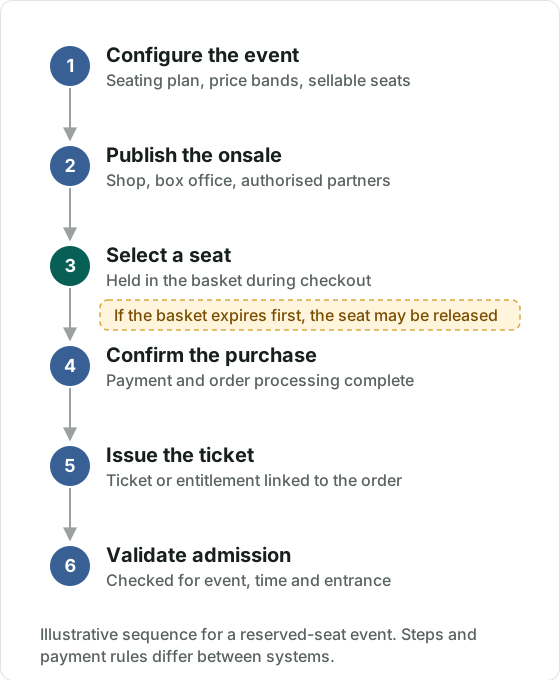
If the customer’s basket expires before confirmation, the system may release B12 for another buyer after the relevant checks. If a payment is still processing, releasing the seat prematurely can create a reconciliation problem. Inventory reservation and payment processing are related, but they are not the same operation.
This lifecycle also applies, with variations, to general admission, timed-entry attractions and multi-day events. A timed-entry attraction might manage a quantity of admissions for each hour instead of individually numbered seats.
What types of ticketing platforms exist?
Ticketing platforms differ mainly in who operates them and how much of the sales journey their customer can control. Three common approaches illustrate the range:
- Organiser self-service software gives an event organiser tools to publish events, set prices and sell tickets, often with a largely predefined checkout. This can be appropriate for a relatively straightforward event operation.
- Venue or enterprise ticketing platforms are built around more demanding workflows: seating plans, box office, memberships, multiple events, permissions, reporting and integrations with other systems.
- Ticketing infrastructure for other businesses provides underlying capabilities—such as event management, inventory, booking or ticket issuing—that a separate ticketing company or enterprise uses under its own brand or within its own product.
These are descriptions of service models, not a quality ranking. Providers can combine them. A platform may serve individual organisers, operate its own marketplace and expose APIs to partner businesses.
How is a ticketing platform different from software, infrastructure or a marketplace?
The terms overlap, but they describe different aspects of the ticketing business.
Example: A ticketing company could operate a consumer marketplace using third-party ticketing infrastructure. A stadium could use the same infrastructure behind its own app without running a marketplace. Another provider could deliver the entire consumer experience and backend together.
A useful evaluation starts with the actual operating model: who controls event setup, inventory, brand, customer data, payment relationships, reporting and support? Product labels alone rarely answer all of those questions.
What should an organisation look for in a ticketing platform?
The right ticketing platform is the one that can support the organisation’s events, customer experience and operational responsibilities without introducing unacceptable cost or dependency. Requirements should come before feature comparisons.
For a small organiser, the essentials might be clear event setup, easy checkout, straightforward ticket scanning and predictable fees. A multi-venue operator may need consistent reporting across locations while allowing different staff permissions and box-office processes. An established ticketing business may care more about custom interfaces, payment choices, API access, commercial autonomy and expanding into new event sectors.
Useful evaluation questions include:
- Can the system model the events we actually run—reserved seating, general admission, timed entry or recurring performances?
- How does it handle capacity, basket reservations, cancellations and tickets sold through other channels?
- Which parts of checkout, customer identity and ticket delivery can we configure or integrate?
- Who controls settlement, refunds, customer records and operational data exports?
- What happens during unusually high traffic, an internet outage or a failed payment?
- Which tasks can our team handle directly, and which require supplier support or custom development?
There is no universally required feature list for every ticketing operation. A highly configurable platform adds little value if the business needs a simple checkout; a minimal ticket seller may become restrictive when multiple venues, brands or integrations must work together.
In short: a ticketing platform connects inventory, orders and ticket validity throughout an event’s lifecycle. The most important differences between platforms are the workflows they support, the control they provide and how they fit into the wider operation.